
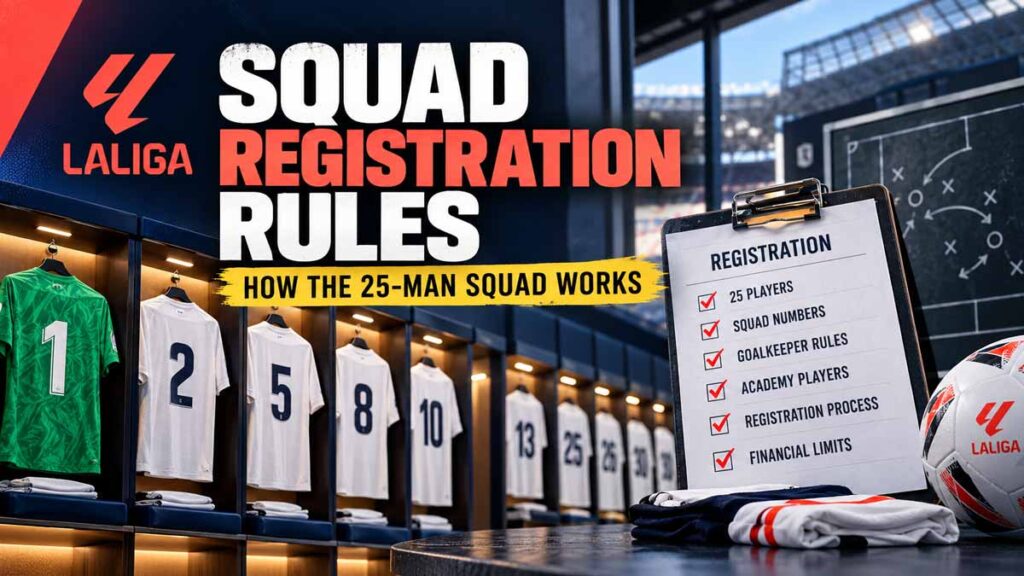
Why can a LaLiga club sign a player but still have trouble registering him? Why do first-team players normally wear numbers from 1 to 25, while academy players appear with numbers from 26 upward?
Building a LaLiga squad involves more than simply signing players. Spain’s professional clubs have to follow registration, squad-number and financial-control rules that determine who can be registered with the first team and who can actually compete.
Quick answer: LaLiga first-team squad numbers run from 1 to 25. Numbers 1, 13 and 25 are reserved for goalkeepers, eligible reserve or dependent-team players use fixed numbers from 26 upward, and clubs must also satisfy LaLiga’s financial registration rules.

What Are the Main LaLiga Squad Rules?
The basic structure is straightforward once squad places, player status and financial registration are separated.
- First-team squad numbers run from 1 to 25.
- Numbers 1, 13 and 25 are reserved for goalkeeper registrations.
- Eligible players appearing from reserve or dependent teams use fixed numbers from 26 upward.
- A club’s ability to register players is also affected by LaLiga’s Squad Cost Limit.
- Signing a player and registering that player to compete are not necessarily the same step.
This combination of sporting and financial regulations explains why player registration becomes such an important issue during transfer windows.
How Many Players Can a LaLiga Team Register?
A standard LaLiga first-team squad effectively has room for up to 25 first-team registrations, reflected in the competition’s numbering system. RFEF competition rules specify that first-team player numbers are between 1 and 25.
That does not mean every club must fill all 25 places. A team can operate with fewer first-team registrations and supplement its matchday options with eligible players belonging to its reserve or dependent teams.
This is why looking at a club’s entire player pool can sometimes make its squad appear larger than 25. For an overview of the clubs currently competing in the division, see our La Liga teams guide.
Why Do LaLiga Players Wear Numbers 1 to 25?
Unlike competitions where senior players can routinely choose almost any large squad number, Spain uses a more structured numbering system. First-team players in the Primera División are assigned numbers from 1 through 25.
The system makes a player’s number useful for understanding his registration status. A number between 1 and 25 generally indicates a first-team registration, while a player appearing with a number from 26 upward may be playing under a reserve or dependent-team registration.
Which LaLiga Numbers Are Reserved for Goalkeepers?
Three first-team numbers have particular importance:
| Squad Number | Registration Use |
|---|---|
| 1 | Goalkeeper |
| 13 | Goalkeeper |
| 25 | Possible third first-team goalkeeper |
RFEF competition rules reserve numbers 1, 13 and 25 for goalkeeper registrations. If a club registers three first-team goalkeepers, an outfield player cannot simply take No. 25 because that number is allocated for the third goalkeeper.
Why Do Young LaLiga Players Wear Numbers Above 25?
A talented academy player can train with the senior side and appear in LaLiga without initially holding one of the club’s 1–25 registrations.
Eligible players belonging to reserve or dependent teams who appear for the senior side use a fixed number starting from 26. So when you see a young player wearing No. 27, 30, 32 or another number above 25, it can indicate that he is registered through the club’s lower-level structure rather than occupying a standard first-team squad number.
It is therefore not simply a shirt-number preference.
Can B-Team Players Play for a LaLiga First Team?
Yes. Spanish clubs commonly operate reserve sides and extensive youth systems, and eligible players from those teams can appear for the senior side under the applicable federation rules.
A young player does not necessarily need to immediately occupy one of the 25 first-team numbers simply because he has made his LaLiga debut. However, eligibility and registration status still matter; being part of an academy does not automatically mean every youth player can be placed into a LaLiga match at any time.
Signing vs Registration: What’s the Difference?
A club can agree a transfer and sign a contract with a player, but the player must also satisfy the necessary registration requirements before representing the club in LaLiga.
| Stage | What It Means |
|---|---|
| Signing | The club acquires or contracts the player. |
| Registration | The player is approved to participate for the club under the applicable competition rules. |
Most transfers complete both processes without much public attention. The distinction becomes newsworthy when financial or regulatory obstacles prevent or delay registration. See our LaLiga transfers guide for more on how squads change through the market.
Why Can a LaLiga Club Sign a Player but Struggle to Register Him?
The answer often involves LaLiga’s economic-control system. LaLiga applies an individual Squad Cost Limit, known in Spanish as the Límite de Coste de Plantilla Deportiva.
It is not a universal salary cap where every club receives the same spending allowance. Each club has its own limit based on its financial circumstances.
Sporting costs considered by the system include:
- Fixed and variable salaries
- Social Security costs
- Collective bonuses
- Player acquisition costs
- Agent commissions
- Transfer-fee amortisation
The calculation extends beyond the starting XI and can include costs connected with first-team coaching staff, reserve teams, youth structures and other sporting areas.
How Does the Squad Cost Limit Affect Registration?
A club’s available squad-cost capacity matters when registering players. Having enough cash to pay a transfer fee does not automatically give a club unlimited freedom to add players.
A club may need to create registration capacity by reducing squad costs, transferring players or generating qualifying financial room under LaLiga’s regulations. That is why a headline saying a club cannot register a signing should not automatically be interpreted as meaning the transfer itself is invalid.
Key distinction: an unused squad number and sufficient financial registration capacity are two different things.
Player wages are only one part of squad costs. For additional context, see our guide to the highest-paid LaLiga players.
Is LaLiga’s Squad Cost Limit the Same for Every Club?
No. Each club has an individual Squad Cost Limit. The club proposes its limit according to the relevant budget rules, while LaLiga’s Validation Body approves it or adjusts it to a level considered compatible with the club’s financial stability.
Two clubs competing in the same league can therefore have dramatically different spending capacity, and those limits can change as their financial situations change.
Is the Squad Cost Limit Just Player Salaries?
No. Calling it a “salary cap” is convenient but incomplete. Player salaries matter, but the Squad Cost Limit can also incorporate bonuses, Social Security, acquisition costs, agent commissions and the annual amortisation of transfer fees.
This is why estimating a club’s registration capacity by simply adding up publicly reported weekly wages can be misleading.
Why Does Transfer-Fee Amortisation Matter?
Transfer fees are commonly accounted for across the length of a player’s contract rather than treated solely as a one-season squad cost.
For a simplified example, imagine a club pays €50 million for a player on a five-year contract. The transfer cost could represent approximately €10 million per year in amortisation before considering salary and other applicable costs.
Real-world accounting can be more complicated, but the example explains why both transfer fees and contract length can affect squad-cost calculations.
Can LaLiga Clubs Leave Squad Numbers Empty?
Yes. A club does not have to use every available first-team number and can operate without all 25 places being occupied.
An empty number does not mean the club can automatically register any player it wants. The player must still satisfy registration requirements, while the club must have the necessary financial capacity under LaLiga’s rules.
What Happens During the January Transfer Window?
Squads can change during the winter registration period. Clubs may sell, loan, sign or register players and adjust their first-team composition subject to the applicable competition and financial rules.
A number that becomes available can potentially be reassigned as registrations change, but an open squad number alone does not guarantee that a new player can be registered.
Why LaLiga Registration Rules Matter
These rules affect far more than paperwork. They influence transfer strategy, whether a new signing can immediately play, decisions to sell or loan players, contract structures, academy promotions, squad-number choices, January transfer activity and how clubs manage their finances.
Understanding the system makes many seemingly confusing LaLiga transfer stories much easier to follow.
Frequently Asked Questions
The first-team numbering structure provides numbers 1 through 25, effectively creating up to 25 first-team registration places, subject to goalkeeper-number rules and all other registration requirements.
An eligible player appearing from a club’s reserve or dependent structure can use a fixed number from 26 upward, which is why young players can appear with numbers such as 30.
LaLiga first-team squad numbering operates within the 1–25 range rather than allowing unrestricted high numbers for standard first-team registrations.
Yes. Eligible reserve and academy players can appear for the senior team under the applicable registration rules.
Yes. No. 25 is reserved for a possible third goalkeeper registered with the first team.
Yes. Numbers 1 and 13 are reserved for goalkeepers.
No. Each club has its own Squad Cost Limit based on its financial circumstances and the applicable LaLiga economic-control rules.
Yes. Agreeing a transfer or contract does not by itself guarantee that the player satisfies the requirements for LaLiga competition registration.
Not necessarily. The club also needs to satisfy the relevant sporting, administrative and financial registration requirements.
The Bottom Line
LaLiga’s squad system is easier to understand once three concepts are separated:
- Squad places: first-team numbers run from 1 to 25.
- Player status: eligible reserve or dependent-team players who appear for the senior side use fixed numbers from 26 upward.
- Registration capacity: clubs must also satisfy LaLiga’s financial and administrative rules before players can be registered.
Together, those rules explain why squad numbers, academy players and financial limits become major talking points during every Spanish transfer window.
Signing the player is one step. Registering him to play in LaLiga is another.
Primary references: RFEF competition regulations and LaLiga’s official economic-control and Squad Cost Limit documentation.
